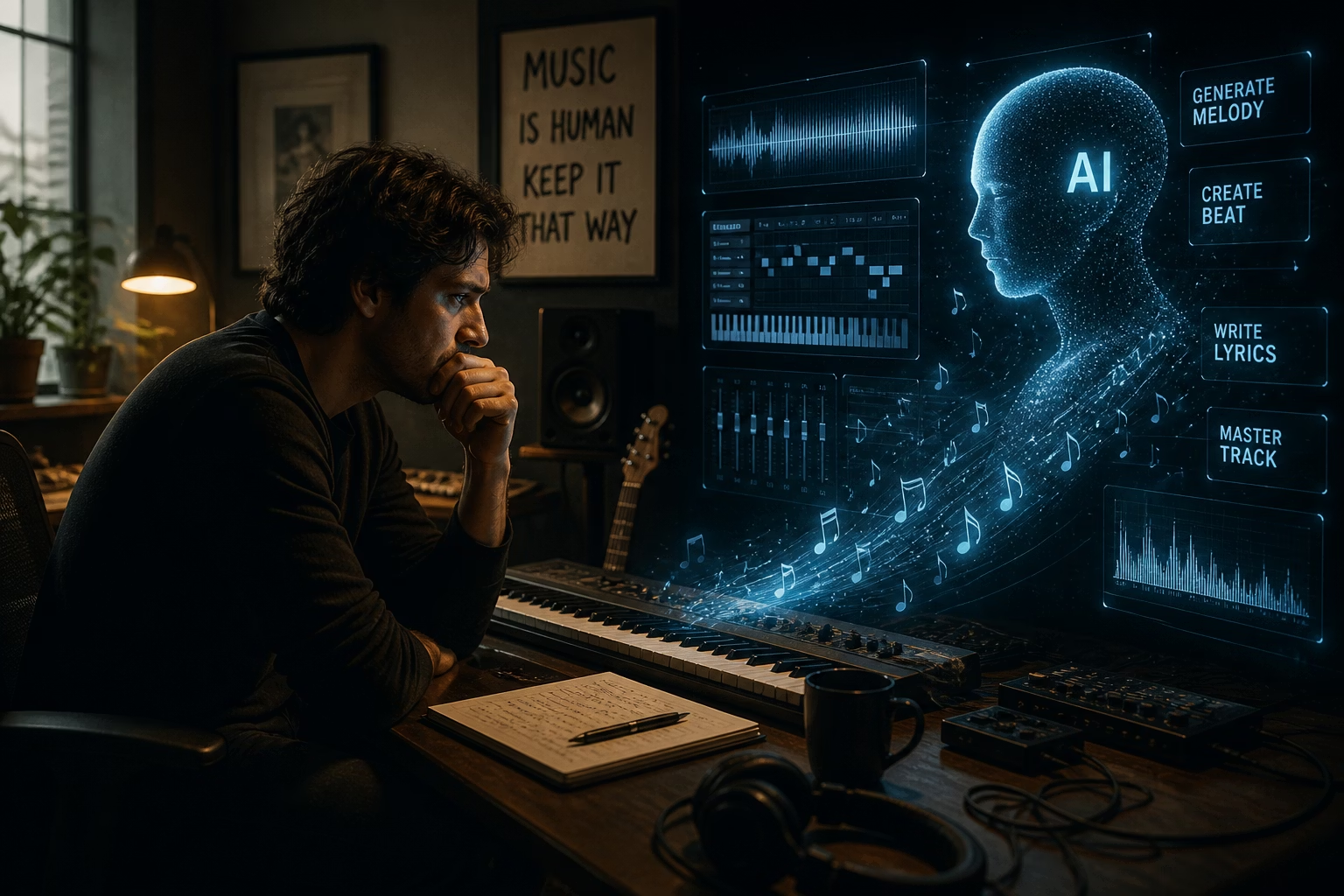

I believe this threat is a paper tiger, and my argument begins with an Elizabethan escaped convict…
At the beginning of the 17th Century, towards the end of the reign of Elizabeth I, a recusant Catholic philosopher was languishing in a jail cell, writing a book about what it is to be human. He escaped from prison, revised his work and finally published it in 1604, titled ‘The Passions of the Minde in Generall’.
His name was Thomas Wright, and I reckon he can lay claim to the first published reference to ‘cells’ in the human body. If you check Wikipedia, it will tell you this accolade goes to Robert Hooke’s scientific text, Micrographia, written in 1665. But Thomas Wright got there first, over half a century earlier, in a passage explaining how we hear sound:
Sound passeth thorow the eares, and by them unto the heart, and there beateth and tickleth it in such sort, as it is moved with semblable passions… musick in those cels plaieth with the vital and animate spirits, the only instruments and spurs of the passions.
In another passage, he describes the effect of music on the listener:
It moveth a man to mirth and pleasure, and affecteth him with sorrow and sadnesse; it inciteth to devotion, and inciteth to dissolution: it stirreth up souldiers to warre, and allureth citizens to peace… musicke in like manner elevateth the mind to devotion and pitie, and abaseth the soule with effusion and levity.
How can music achieve such varied and significant effects on us? One of the most successful story tellers of all time, and the most performed playwright in history, William Shakespeare, knew all about these seemingly magical effects music has on us, which is why he included a vast amount of it in his work. The first recorded performance of The Merchant of Venice was in 1605, a year after the publication of Thomas Wright’s work.
In the final act, the character of Lorenzo describes the striking effect music can have, in a speech reminiscent of Thomas Wright’s observations:
For do but note a wild and wanton herd,
Or race of youthful and unhandled colts,
Fetching mad bounds, bellowing and neighing loud,
Which is the hot condition of their blood;
If they but hear perchance a trumpet sound,
Or any air of music touch their ears,
You shall perceive them make a mutual stand,
Their savage eyes turn'd to a modest gaze
By the sweet power of music…
Throughout the Renaissance, the Elizabethans had become obsessed by music, the ultimate discipline at the nexus of art and science. They were amazed by sonic phenomena such as sympathetic resonance, regarded musical accomplishment as an essential component for aspiring Courtiers and even believed that a person who didn’t love music was not to be trusted. You might still agree with that today.
Many people have attempted to define what music actually is, with varying degrees of success. The 17th Century polymath Gottfried Wilhelm von Leibniz, inventor of calculus, understandably had a mathematical focus:
“Music is the pleasure the human soul experiences from counting, without being aware that it is counting”.
Later, the 20th Century composer and ‘father’ of Electronic music, Edgard Varese, had a pithier definition:
'organised sound’.
Attempting to define music is a bit like the often quoted philosophical conundrum ‘if a tree falls in the forest, does it make a sound?’ In my view the answer is ‘no’. Sound - and music - happen in the brain. Although the Sound Engineers and acoustic experts will be up in arms at this, my point is that it’s not even just about the perception part of moving air molecules that’s necessary here, but that crucially, the perception of sound and music is intrinsically linked to the emotional centres of the brain. This is what the Elizabethans were onto.
And what they were discovering about the curious qualities and effects of music, neuroscience began to back up with data, towards the end of the 20th Century. The more that was discovered about the human brain, and how it interacts with music, the clearer it became that the two are inextricably linked.
Steven Pinker’s notoriously provocative comment underplaying the evolutionary purpose of music as ‘auditory cheesecake’ has increasingly been discredited, and, as Daniel Levitin observed in his seminal book on the subject ‘This Is Your Brain on Music’, in fact -
“humans are hardwired for music”.
This is key in understanding why Generative AI will never be able to offer a convincing alternative to music created or performed by a human.
When you think about the end to end process of music, it’s pretty weird. Someone expresses their feelings by conceiving of a particular structure of vibrational frequencies and timbres, which are then most often written down using a set of codified hieroglyphics, which another person or group then translates, interprets and performs either with their voice or instrument, vibrating air molecules around them, which then enter our ears and are processed not only by the auditory networks in our brains, but also the networks associated with language and emotion.
As Benedick comments in Much Ado About Nothing, when the song ‘Sigh No More, Ladies’ begins:
"Is it not strange that sheep's guts should hale souls out of men's bodies?"
Turns out, it’s not as strange as you might at first think. Phillip Ball noted in his book ‘The Music Instinct’ that music is ubiquitous across all human cultures - and “is ingrained in our auditory, cognitive and motor functions … you could not eliminate it from our cultures without changing our brains.”
Annett Schirmer’s neuroscientific study on rhythm concluded that rhythmic sound
“not only coordinates the behaviour of people in a group, it also coordinates their thinking — the mental processes of individuals in the group become synchronized.”
Sinichi Suzuki, the pioneer of music education, even related a conversation with Albert Einstein, who attributed his groundbreaking work to a surprising source:
“The theory of relativity occurred to me by intuition, and music was the driving force behind that intuition… My new discovery was the result of musical perception.”
It’s no wonder a writer like Shakespeare saw the benefits of using music at key dramatic moments, when it’s essentially like casting a spell on our brains.
This is all to say that we humans are highly emotional creatures, and music, perhaps more than any other phenomenon, can influence our emotions in strikingly significant and subtle ways.
Susan Rogers, professor in music cognition and psychoacoustics (and previously a sound engineer & producer for Prince), alternatively describes the recently identified ‘default mode network’ within our brains as the ‘Mind-Wandering’ Network.
In her book, ‘This is What It Sounds Like’, she explains how our brains treat listening to music as a special form of daydreaming, during which there is significant activity across this ‘Mind-Wandering’ Network.
“Our auditory circuitry has more varied and more direct connections to our emotion circuitry than does our visual circuitry. This is due to our brain’s capacity for language, arguably the most important mental tool in the Homo sapiens survival kit. Because of this, music activates our Mind-Wandering Network and our personal self more easily and fully than any other art form.”
This is why we can react very strongly when hearing music we don’t like – it contradicts our very sense of self. And why certain aspects of music can evoke specific and very strong emotional responses.
AI can fake certain kinds of music pretty well. But if a film, or advert, or play, or concert relies on music to convey an emotional message, fakery just won’t cut it. We humans have 300,000 years of practice under our belts, relying on listening to our gut.
So you composers and producers and musicians who vibrate air molecules for a living, you need not fear AI. And those of you who commission that music - if you want it to do its job effectively, you need the real thing.
Ultimately, the ‘sweet power of music’ that occurs in the liminal zone of vibrating air molecules and our nervous systems, as Thomas Wright observed, is a uniquely human experience.