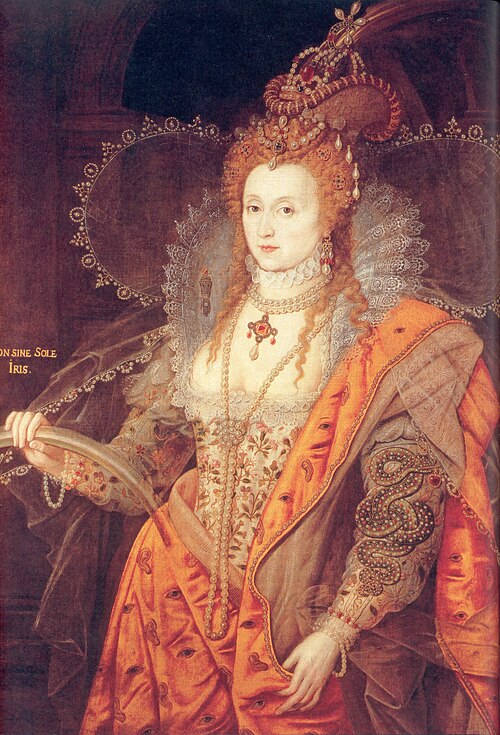

In the Marble Hall at Hatfield House in Hertfordshire, an opulent gilt frame hangs under a carved gallery on the East Wall, dominating the room. The painting within the frame is the last portrait made of Queen Elizabeth I, before her death at the age of 69.
The work is imbued with symbolism, depicting the monarch as a divine source of light and peace for a nation traumatised in an era dominated by conspiracies, subterfuge and religious turmoil. The spiritual and political success of England’s Virgin Queen, immortalised by a virtuosic piece of artistic propaganda.
But there is another message within the brushstrokes.
Elizabeth’s reign was defined by duality. At a religious level, the confusion of spiritual loyalty between Catholicism and Protestantism dominated the English Reformation. Politically, the projection of the Monarch as the ‘Body Natural’ versus the ‘Body Politic’ was a rationalisation of a fundamentally contradictory concept. And perhaps, most notably, the duality of Elizabeth's reign was exemplified by the explosion of literature bursting with illusion and allegory, the artistic expression of a nation, drenched in double meanings.
England’s favourite playwright, who famously relied on his audience’s imagination, needed to manipulate their senses throughout his dramatic narratives. One of the most powerful tools at Shakespeare's disposal to achieve this was music, with its seemingly magical ability to combine and interchange modalities of perception, radically affecting what the audience were seeing and hearing.
This combination of senses is emblazoned on the canvas of the painting at Hatfield House. And how these senses combine to fire the imagination, so crucial to Shakespeare’s plays, was codified four hundred years later by an experimental psychologist at Oxford University.
In one of the most striking aspects of the picture, perhaps more so than Elizabeth clutching a rainbow in her right hand, are the decorative features on her opulent gown.
The embroidery displays dozens of human eyes and ears, on one of the most intriguing pieces of Haute Couture ever made, worn by Elizabeth I in the Rainbow Portrait...
_____________________________________________________________________________________________________
Elizabeth had led the country through existential turbulence, largely under the guidance of her spymaster, Francis Walsingham, whose network of agents, watchers, messengers and assassins defeated threat after threat to Elizabeth and to the realm itself.
The political symbolism within the embroidery is clear: Elizabeth and her surveillance network were all-seeing and all-hearing. There is even a theory that the creases in the silk represent mouths, emphasising the need to impart what our senses inform us.
A year before the Rainbow Portrait was completed, Shakespeare was creating a different form of propaganda.
When he returned to the Histories cycle of plays in 1599, the significance of the reign of Henry V could not be underestimated for an Elizabethan audience. The play needed to stir the emotions of a nation undergoing an identity crisis and deal with the fact that, however successful her reign, threats to the realm continued due to the lack of an heir to the throne.
Shakespeare’s awareness of our visual and auditory senses, and how they can fire the imagination in dramatic storytelling, were highlighted in his Prologue to Henry V, which sets out a manifesto to theatre goers as important now as it was when he wrote it.
His stroke of genius was to remind the audience of the most powerful storytelling device there is - imagination.
In setting out the scene and characters we are about to witness, the apologetic tone of what may be lacking within the constraints of a wooden scaffold stage is mitigated by a helpful suggestion:
“… let us, ciphers to this great account,
On your imaginary forces work.”
The message is reinforced:
“Piece out our imperfections with your thoughts.”
And a tangible example is offered:
“Think, when we talk of horses, that you see them
Printing their proud hoofs i’ th’ receiving earth”
What Shakespeare was proposing here is visualisation.
The Prologue to Henry V highlights that, whatever material deficiencies are present in a theatre environment, the power of suggestion will more than compensate. And the brain’s ability to imagine things that aren’t actually there is supercharged by sound and music, in two interesting ways.
One is music’s capability for mimesis. And the other is cross-modal correspondence.
Our brains commonly and reliably make intuitive associations when hearing music, between audible attributes such as timbre, tempo and pitch, with other senses such as touch, spatial awareness and vision. Our perception is structured by the unconscious mapping going on in the brain, and in dramatic contexts, cross-modal correspondence acts like rocket fuel to the imagination.
Dr. Charles Spence, an experimental psychologist at the University of Oxford, originally coined the term "crossmodal correspondences", in the work with his team at the Crossmodal Research Laboratory. The main types of correspondence that predictably map to musical attributes in our brains are colours, space and size, textures and emotions.
High pitches and major tonalities often map to bright colours, while low pitch and minor tonalities often suggest dark hues. We also instinctively match high pitches to small objects, sharp angles and more elevated spaces, while low pitches correspond to smoother and larger objects and lower spaces. The timbre and articulation of instruments also correlate to tactile senses, with brighter sounding instruments such as brass and woodwinds, as well as shorter articulations, suggesting spikier textures, while mellower timbres such as strings or harp, and smoother, more sustained articulations, suggesting softer and smoother textures.
Perhaps one of the best known examples of musical cross-modal correspondence in action is from a 1970s film score, when special effects were much more limited than those available to film makers now. In the same way that Shakespeare recognised the need for the audience to tap into their imagination, to mitigate the shortcomings of a wooden scaffold stage, Stephen Spielberg was dealing with similar challenges.
When adapting the pulp fiction best seller novel by Peter Benchley, Spielberg had one main obstacle in making Jaws - how to create a shark. He needed to produce a sense of threat in the minds of the audience, without being able to rely on either physical or post-production visual effects, which were limited at the time. He had to find a way to fire the audience’s imagination. John Williams provided the solution.
If you ask a friend how the Jaws music goes, they will invariably deliver a melodramatic musical pantomime which contains about as much threat as an Easter bunny. It’s worth listening again to John Williams’ score, with a specific ear on how he creates cross-modal correspondence in the music. The first thing your friend will get wrong is the very opening of the music. They will sing two notes. The actual cue starts with a single pitch. The pitch is low and quiet, played by the double basses, which immediately conjures an idea of something large and heavy, in the depths, distant and alone.
The beauty of music’s power of suggestion lies not just in its abstract capabilities, but in the potential for constant evolution and real-time change. What starts as a single note in John Williams' music very gradually takes shape. One note becomes a blurring of two notes, which then come into sharper focus. The distance between those notes is a semi-tone, suggesting a minor tonality, and therefore something dark and ominous. The rhythm and pace of the music increases, suggesting movement and gathering proximity. The addition of brass and woodwinds, with off-kilter rhythmic accents peppered throughout the ostinato pulse underneath, conjure a muscular force, both graceful and jagged in its movement, reaching a flurry of articulated high pitch snaps, as close as any music will ever get to literally creating in our brains the image of 50 glistening sharp shark teeth ferociously biting its prey.
In the film, we don’t see the shark in full until the end, and it’s a disappointment. Throughout the film, the music IS the shark, firing our imagination more effectively than anything we can see with our eyes.
Music in drama falls into one of two categories: diegetic and non-diegetic. Diegetic music exists in the world of the characters - music they can hear on a radio, or performed in a bar for example. Non-diegetic music is the opposite - it’s music that the audience can hear, but the characters can’t. Composer Michael Bruce has this to say about the potential for non-diegetic music in a dramatic context, in his book ‘Writing Music for the Stage’, describing the need for the music to sometimes reflect the psychological action, as opposed to the physical:
‘You may come across a situation where music feels like it should emanate from character rather than geography or historical context. It can be better to frame the drama inherent in a character’s situation and the choices they make, rather than musically to paint the room they make those choices in. This approach opens the door to a huge variety of styles that have little or nothing to do with traditionally accurate music of the time period but can bring your score much closer to the moving line of the narrative.’
A great example in the Shakespeare repertoire, when music can very effectively support and enhance a sense of a character's psychology with non-diegetic music, is the famous dagger scene in Macbeth.
In exactly the same way that music conjures the shark in Jaws, the dagger can assume a tangible presence in this scene, purely with the use of music.
What’s really interesting here is that the music can be both non-diegetic and diegetic at the same time. Macbeth doesn’t ‘hear’ the music, but he certainly ‘sees’ the dagger, creating a mind-bending overlap of cross-modal correspondence which blurs the senses and enhances both Macbeth’s, and the audience’s, sense of foreboding.
The other side of the coin to cross-modal correspondence, is mimesis - music’s ability to artistically simulate, imitate and express nature, reality and human emotions.
How does music do this? The basic building blocks of music comprise three main elements: rhythm, melody and harmony. These are the raw materials of music. It’s when those raw materials are imbued with attributes that the possibilities of mimesis emerge. One fundamental attribute of musical sound is timbre, which translates literally as ‘colour’.
We perceive timbre as a quality of the sound that distinguishes it from other sounds. If you hear a melody played on a Flute for example, and then hear exactly the same melody played in exactly the same way on a Violin, the raw musical material has remained the same. The only thing that has changed is a single attribute - the timbre. But this small change can have a significant effect on how we respond to the sound, and in a dramatic context, what that might ‘mean’.
The quality of timbre has a direct, but mostly subconscious, impact on our emotional response to it. The bright, breathy and metallic sweetness of the Flute melody would become something a little less brittle when played on the Violin. It might now sound more yearning, probably with a slightly wider vibrato, and convey a different sense of soulful warmth.
These purely abstract qualities are interesting in themselves, but in a narrative context demonstrate mimesis in action. The mimetic qualities of the timbre of the instrument correlate to qualities of character. Let’s say in a production of Henry V, the Composer decides to consistently associate the sound of a Flute with Queen Isabel of France, and perhaps a Violin is consistently associated with Henry V.
If the Composer has these two instruments begin a duet for the first time in the wooing scene in Act V, a figurative as well as literal marriage takes place on a musical as well as narrative level. This kind of thematic approach to orchestration is a useful tool for composers, even though an audience may not consciously be aware of its deployment. But the mimetic qualities offered by the timbre of different instruments allow a parallel narrative to unfold in the music.
There are many other attributes that the raw musical material can adopt, creating further identifiable features, which contribute to the ability of music to convey meaning. Jason Martineau has this to say, in his book, ‘The Elements of Music’:
“Much of the communication of meaning in music is dependent on opposites”
Arguably, these opposite attributes are more important in conveying dramatic meaning than the 3 basic elements of rhythm, melody & harmony. And crucially, they further illustrate the mimetic possibilities of music via their direct correlation to dramatic aspects of a narrative.
Dynamics (Loud or Quiet) - Impact & Perspective
Tempo (Fast or Slow) - Urgency & Relaxation
Pitch (High or Low) - Character & Weight
Articulation (Long or Short) - Smooth & Jagged
Chromaticism (Consonant or Dissonant) - Cohesion & Tension
Cadence (Unresolved or Resolved) - Questions & Answers
One of the most important and obvious attributes is the dynamic - whether the music is loud or quiet. These opposite musical qualities correlate in a dramatic context to a sense of impact and perspective. Loudness can suggest the immediacy of an opposing army, while quietness automatically suggests distance - perhaps the same marching enemy force, but at some distance off.
And of course, what’s really useful with dynamics is the scope it offers when changing within the continuum from one extreme to the other. When Henry pauses to rally his troops before the assault on Harfleur, if this moment is underscored, the quietness of the music can help to establish a stillness and a sense of time pausing.
As Henry’s 'once more unto the breech' speech gathers momentum, a musical swell can crescendo along with the emotion in the message and operate on two levels at once: not only can it rise along with the internal emotional response amongst the troops (and us, the audience) to Henry’s speech, but can also spill over into the diegetic alarum sounded at the final charge, taking us back into the visceral immediacy of the action.
Another fundamental musical attribute, that again has opposite extremes, is the tempo - whether the music is fast or slow. These states translate to a dramatic implication of pace, and either a sense of urgency or relaxation. The faster the music, the more our heart rate increases and the more we feel immediacy or excitement.
There are many more opposing attributes which evoke mimetic qualities. The melody can progress in a stepwise motion, or take more extreme leaps. Smaller, step-wise melodic contours can suggest a sense of measured formality, while wider leaps can evoke a more extreme emotional range. The harmony can remain consonant, suggesting a sense of order and calm, while dissonant harmonies create tension or disturbance. And as we’ve seen, the pitch of a note can immediately suggest a sense of stature, with high pitch suggesting lightness or youth, with low pitch suggesting weight and authority.
It’s interesting to note though, that even though these opposite attributes can have clearly defined and somewhat polarised mimetic qualities at first glance, the range across the continuum expands the possibilities. Music typically has multiple, overlapping attributes at play concurrently.
What if the music is slow and loud? The initial feeling of relaxation from a slower tempo can quickly evolve to an impending sense of threat. The layers of nuance can add complexity and a richness to the musical narrative.
A great example of musical mimesis, again from a film score, is the music for Alfred Hitchcock’s 1960 horror-thriller film ‘Psycho’, which was released at a time when the depiction of violence on screen was much more limited than that we encounter today. His composer, Bernard Hermann, needed to amplify the shock of a knife attack which could only be implied on screen, rather than actually seen.
Hermann’s music is as shocking now to a contemporary audience as it was in 1960, and left many viewers convinced they had witnessed more than is actually visible on screen.
The cue is a prime example of mimesis - musical onomatopoeia in action, suggesting the repetitive, slashing of a sharp blade, and utilising many of the opposite attributes mentioned earlier – loud to quiet, high pitch to low pitch, fast to slow tempo, as well as exploiting the specific timbre created by string instruments played with a bow. The slashing effect is memorably achieved by the unique combination of techniques only available to string players: as the bow whips at the strings, the fingers quickly glide up the neck, creating a fast portamento which blurs the sense of pitch and establishes, in a similar way to John Williams’ Jaws theme, as close as you’ll ever hear to the idea of a knife attack expressed in musical sound.
Music has an incredible ability not only to stimulate the senses, but create the source for perceptual crossovers which fire the imagination in complex and subconscious ways. The motto inscripted on the Rainbow Portrait sums this up nicely.
Above Elizabeth’s right hand, there are 4 words of Latin: “Non sine sole iris” - ‘No rainbow without the sun’. At the end of her reign, the symbolism of the ‘rainbow’ - peace & prosperity across the realm - was only possible due to its source of power & light, Elizabeth.
As a parallel to Elizabeth being the source of light for the rainbow, music can be the source for imagination.
About 70 years after the Rainbow Portrait was finished, Sir Isaac Newton deconstructed what a rainbow is, when he observed the refraction of light waves through a prism. Interestingly, he initially only observed five colours, but decided to include two more. This decision was as much a mystical decision as a scientific one. He did this to align the seven observed divisions of the light spectrum with the seven notes of the major scale - the fundamental structure of pitch frequencies upon which all of Western music is built.
He was making an inextricable link between the perceptual sense of sight and sound, and in his manuscript, allocated a musical note to each colour.
Maybe he was onto something.